Professional Photo Book Publishing Services in Canada
Transform a photography collection, family archive, travel project, artistic portfolio, or visual history into a professionally produced book. Our photo book publishing services bring image selection, sequencing, design, prepress preparation, printing guidance, and publishing support into one coordinated process.
Photographers and creators who want to self-publish photo book collections can retain creative control while receiving specialist help with the production details that affect image quality, page flow, colour, typography, and the finished physical edition.

How Can You Self-Publish Photo Book Collections Professionally?
Creating an effective photo book requires more than just assembling an array of good photos. Rather, the photos need to be chosen, arranged, sized, colour-checked, and set into layouts that provide a cohesive visual flow.
A great book may have a chronological order, geographical order, thematic order, emotional arc, or any other type of ordering logic. Individual photos that look great in isolation may not necessarily be arranged effectively in the flow of the book.
Our photo book publishing process begins by understanding your project fundamentals:
A wedding album, documentary project, artist monograph, travel collection, corporate history, and memorial book each require a different design and production strategy.
Turn a Photography Collection Into a Coherent Visual Story
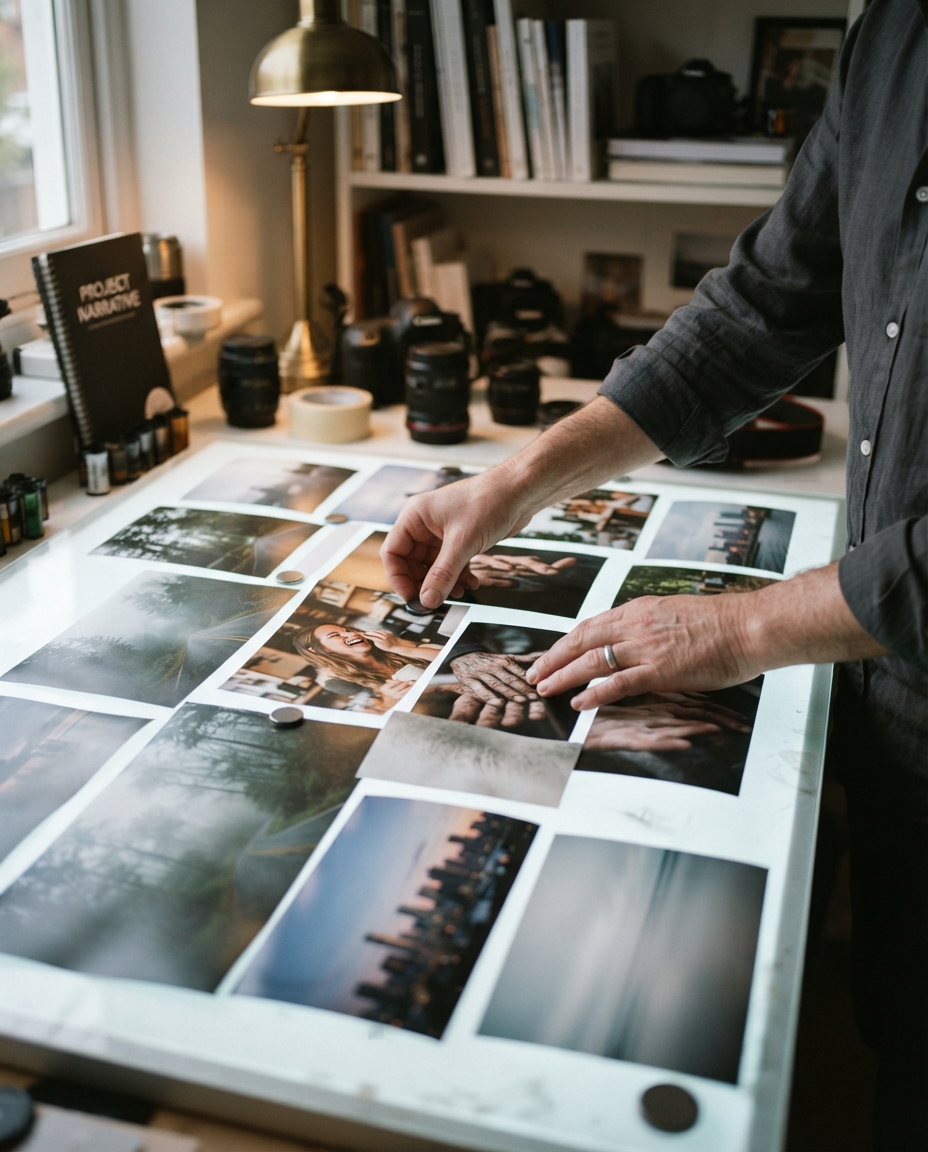
Professional photo book publishing services should help the reader move through the images with purpose. This means making decisions about what to include, what to remove, which photographs deserve full-page treatment, and where text can provide helpful context.
Our team can work with the photographer’s existing sequence or help develop a new one. We consider subject changes, visual rhythm, colour relationships, repeated compositions, orientation, scale, and the emotional effect of each page turn.
Authors comparing photo book publishing companies should verify whether image sequencing, prepress checks, physical proofs, corrections, and final print specs are included.
Self-Publish Photo Book Projects Without Losing Creative Control
A photo book reflects the photographer’s eye. Professional support should refine the presentation without replacing the creator’s visual intention.
You approve the image selection, sequence, cover direction, page layouts, cropping decisions, captions, paper considerations, and final files. The designer may recommend changes to improve consistency, but significant visual decisions are never made without your consent.
You approve the photographs, narrative direction, design concepts, trim size, orientation, paper stock, planned editions, and final production files.
Depending on your package, specialists assist with image review, sequencing, layout design, captions, proofreading, cover design, prepress preparation, proof review, ISBN, and publishing setup.
Not automatically. Screens emit light while paper reflects it. Paper stock, ink, printer gamut, colour profiles, and resolution affect the finished result; we guide your prepress calibration.
A Publishing Plan Based on Your Images and Format
The price of photo book publishing services depends on the project’s image count, page count, dimensions, layout complexity, paper, binding, proofing requirements, and print quantity. A 40-page family keepsake does not require the same production plan as a 200-page fine-art monograph. A short-run hardcover also has different costs and limitations from a print-on-demand paperback.
A reliable photo book publishing company explains what the quote includes and identifies any printing, shipping, retouching, licensing, or third-party production costs transparently.
Photo Books Designed for the Way Images Are Viewed
A photo book is not simply a gallery transferred to paper. Image scale, page proportions, white space, gutter placement, and sequence can change how a photograph is perceived.
Important faces, text, or details should not disappear into the binding. Full-bleed images must extend beyond the trim line according to printer specs. Captions should remain legible without competing with the photography. We support projects across all genres:
How Do Photo Book Publishing Services Manage Production?
A structured 12-step workflow helps protect image quality while giving the creator clear review and approval milestones.
We review the book’s purpose, audience, image quantity, available resolution, written material, planned size, orientation, and binding.
Files are named, catalogued, and organized so the photographer, editor, and designer reference identical image versions throughout.
Photographs are curated according to chronology, theme, location, visual rhythm, narrative progression, or agreed structure.
Trim size, orientation, page count, paper finish, binding style, print method, and distribution channels are established.
The designer develops sample pages that establish typography, image scale, margins, captions, white space, and visual pacing.
Once the visual direction is approved, all remaining photographs and text are placed into a consistent, dynamic page sequence.
The cover is created around the project’s theme, audience, format, title, author credits, and exact binding spine specifications.
Captions, introductions, essays, credits, acknowledgements, and bios are edited and proofread for precision and tone.
We check for resolution warnings, missing assets, credits, and model/property permission requirements with the creator.
Files are checked against the selected printer’s exact requirements for trim, bleed, gutters, color profiles, and PDF/X export.
Digital or physical proofs are evaluated for layout, cropping, text accuracy, image order, color behavior, and physical binding.
Approved print-ready files, cover files, and book metadata are finalised for printing, distribution, or online retail.
What Separates Professional Photo Book Publishers?
The right photo book publishers understand that photography books require bespoke design, technical production, and visual storytelling—not standard automated templates.
Selection and sequencing consider visual relationships, repetition, transitions, page turns, chronology, and the overall emotional arc.
Layouts are custom designed around each photograph’s aspect ratio and importance, avoiding rigid, cookie-cutter templates.
Trim, bleed, margins, gutter safe zones, paper stock, binding mechanics, and printer colour profiles are calibrated from the beginning.
The project scope clarifies who supplies high-res files, confirms copyright, secures model or property releases, and approves cropping.
Eligible Canadian publishers and photographers are directed to current ISBN Canada registration and Library and Archives Canada deposit requirements.
We guide you through the physics of RGB-to-CMYK color conversion, ink absorbency, and proofing so you achieve predictable, stunning print results.
Support to Self-Publish Photo Book Projects
Comprehensive, modular publishing services tailored specifically for photographers, artists, and families:

We help organize your collection and develop an order that supports the intended narrative, emotional impact, or documentary theme.

Connects image selection, narrative structure, typography, captions, and layout into a seamless, unified publication.

We identify images requiring higher-resolution replacements or specialist retouching before final prepress export.

A coordinated visual system for your cover, opening spreads, photo layouts, captions, essays, and closing credits.

Written elements are reviewed for clarity, consistency, grammar, names, dates, locations, and photographer credits.

Guidance on page dimensions, paper finish, colour process, hardcover or softcover, layflat binding, and cost optimization.
Print-ready files exported according to your chosen printer’s exact requirements for bleed, gutters, margins, and DPI.
Assistance with free ISBN Canada registration, legal deposit compliance, metadata, and setup across online and retail platforms.
Over 9,000+ Books Published & Recognized Nationwide
Explore our portfolio of published titles, including photography monographs, visual portfolios, and fine-art books published across Canada.


Read experiences from photographers, artists, and families who published their photo books with us:

“I had many photos but no particular order. The editor helped me sort out the images, while the designer found the rhythm and made it look deliberate and not overcrowded.”
Claire Montrose Toronto, Canada
“I needed a clean design, without any decoration or templates. The spreads showed me the right direction and I agreed with the cropping and placement of the photos.”
Adrian Wells Calgary, Canada
“I knew about photography but nothing else about trim, bleed, paper or binding. They helped me understand how it all influences my book.”
Naomi Laurent Montréal, Canada
“The photos were from several different decades and of various condition. The project was thoroughly prepared, all the captions were consistent and the order was logical.”
Elliot Fraser Vancouver, CanadaFrequently Asked Questions
Some of these services include image evaluation, sequencing, bespoke layout design, cover design, caption editing, prepress production, proofing, ISBN assistance, and publishing setup.
The process starts with defining your target audience and purpose, curating your photographs, choosing trim format and printer, designing custom spreads, proofreading text, and preparing print-ready files for distribution.
There is no fixed limit. The ideal number depends on trim size, visual rhythm, layout variety, project purpose, and total target page count.
The required resolution depends on the physical dimensions at which each image will be printed (typically 300 DPI at 100% scale) and the specific print process chosen.
They will not match 100% identically because screens emit light (RGB) while paper reflects light (CMYK). Paper stock and ink absorbency also influence colour perception, which is why physical proofing is recommended.
Occasionally, depending on the individual file, desired printed size, condition of the photograph, layout scale, and printer specifications. We evaluate every file to prevent pixelation.
Normally no. Faces, small text, and critical details should be placed strategically away from the gutter since standard bookbinding can obscure content in the center seam (unless using layflat binding).
This depends on how the photographs are used (commercial vs. fine-art editorial) and where they were taken. Authors should confirm model and property releases according to their publishing scope.
Yes. Different editions can be planned simultaneously, although varying requirements of printers, binding styles, format dimensions, and ISBNs will require distinct production files.
Yes. Free ISBNs can be applied to eligible Canadian publications and publishers under the guidelines of ISBN Canada and Library and Archives Canada.
The more that your photographic collection is strengthened by the story behind the images—through thoughtful sequencing, bespoke design, fine materials, and flawless prepress—the more lasting its impact will be. From fine-art monographs and family archives to commercial coffee table books, we provide expert support every step of the way.