Book publishing does not just consist of the initial draft writing process. The author should conduct an assessment of the manuscript in terms of its structure, clarity, accuracy, editing and appearance before offering it to the public. Any hurry in this case may result in mistakes that could have been avoided, bad criticism of the work, and extra costs. A useful assessment allows an author to detect any faults in the book and decide on its further publication or improvement.
Readiness of the manuscript pertains to how the manuscript fulfills the requirements expected of the book for its target market and type of publication. Even an already-written copy may lack structure, contain contradictions, have ineffective transitions, and other similar issues. It is not necessary for all sentences to be flawless; it just means that the manuscript has become ready for further small improvements.
Authors wondering is my manuscript ready to publish should examine the complete reading experience rather than focusing exclusively on spelling. A practical review considers whether the book fulfills its promise, maintains a consistent voice, and provides readers with a clear, satisfying experience.
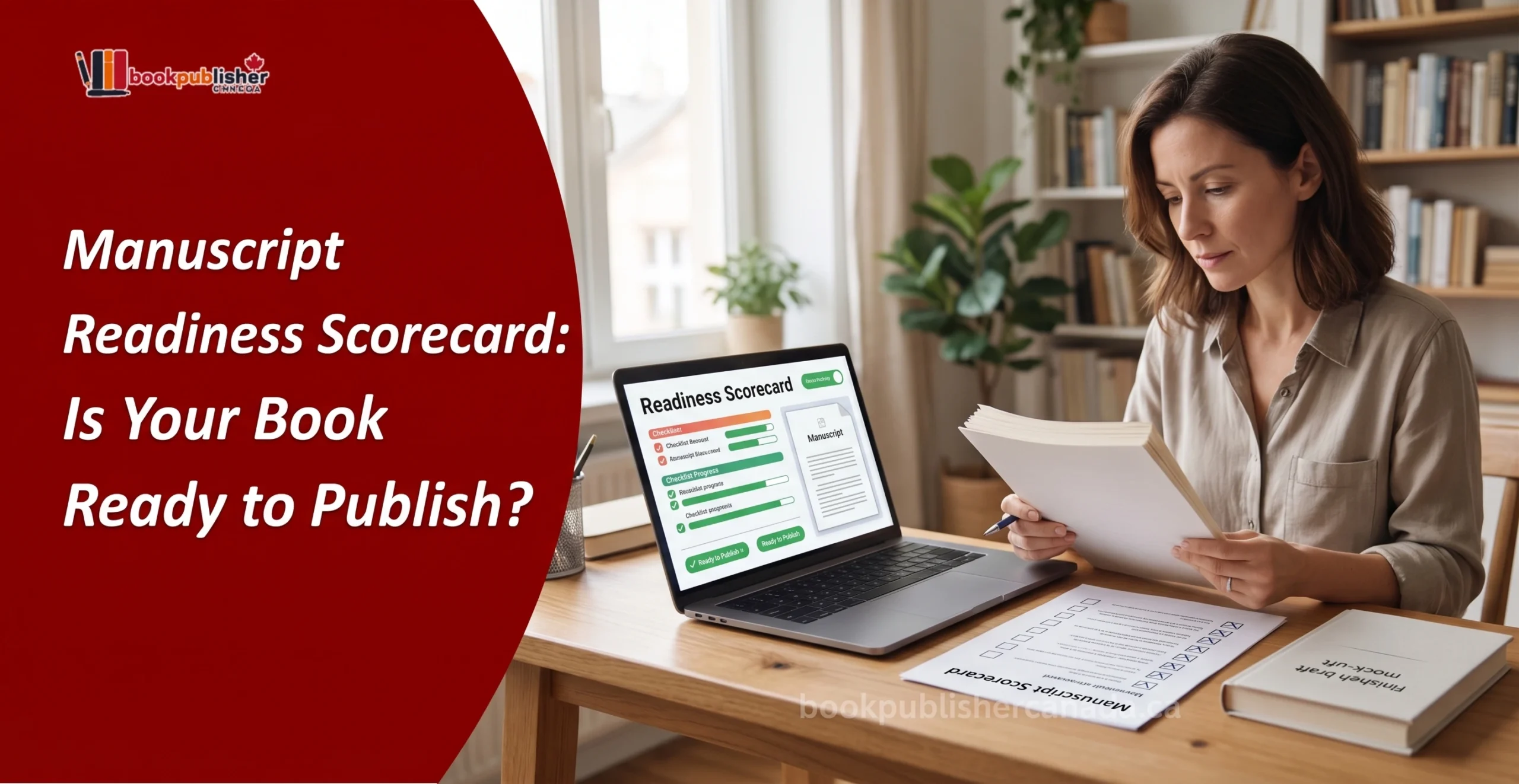
A structured assessment makes it easier to evaluate a manuscript objectively. Instead of relying on personal confidence alone, authors can examine specific quality indicators and record areas that need attention.
A useful manuscript readiness checklist should cover the following areas:
Authors need to go through the entire manuscript from start to finish before reaching any conclusion. Aloud reading of the piece may point out problematic phrasings, and individual chapter reviews will make sure that there is no pacing or repetitive issue.
A scoring rubric is useful for turning that general impression into something actionable. Score the categories on a scale of 1 to 5, with 1 denoting serious problems and 5 denoting publication-level quality.
| Assessment category | Score |
| Organization | /5 |
| Completeness of content | /5 |
| Language and readability | /5 |
| Accuracy and consistency | /5 |
| Editing and proofreading | /5 |
| Audience appropriateness | /5 |
| Presentation and formatting | /5 |
| Total possible score | /35 |
Apply the following guidelines as a rule of thumb rather than a formal criterion for publication:
This manuscript self-assessment is most useful when authors explain the reason behind each score. A low rating for structure, for example, may indicate a need to reorganize chapters rather than correct individual sentences.
Writers can become too familiar with their own work to notice recurring weaknesses. An independent reader can identify confusing explanations, missing context, inconsistent pacing, and sections that fail to engage the intended audience.
A free manuscript review may provide initial observations about a book’s strengths and weaknesses, depending on the provider’s terms. However, authors should confirm what the review includes, whether the entire manuscript is examined, and whether detailed editing is offered separately. A brief sample review should not be confused with a comprehensive editorial assessment.
A professional manuscript evaluation can provide a more structured analysis of organization, narrative development, audience suitability, and overall effectiveness. This can be particularly helpful for complex nonfiction, academic projects, and fiction with multiple storylines.
After the manuscript meets its intended standards, it is time to look into publishing. The right way forward will be determined by the budget, the amount of creative freedom needed, distribution needs, and the kind of professional assistance required.
| Publishing option | Suits best | Consideration |
| Traditional publishing | Authors requiring a publishing company process | Submissions and acceptance criteria vary |
| Independent publishing | Authors desiring more control | The author handles production and service coordination |
| Amazon KDP | Authors who intend to publish digital or print books independently | The files must adhere to platform standards |
| Assisted publishing | Authors who seek assistance in performing certain tasks | Services and charges must be carefully reviewed |
For authors looking for the best Canadian publishers, they need to compare editorial services, publishing contracts, distribution services, and the kinds of books accepted by each publishing company. The reputation of a publishing firm will not determine suitability of the manuscript.
Before making a decision, authors should use a book quality checklist to review content accuracy, editing standards, formatting consistency, and audience suitability. This final review can reveal issues that may affect the reader’s experience and help authors decide whether further revisions are necessary before submitting or publishing their work.
It is also helpful to compare publishing packages, service limitations, and long-term costs. Authors should confirm which services are including, who retains the publishing rights, and whether additional fees apply to revisions, distribution, or marketing. These checks can prevent misunderstandings and help writers choose a publishing route that matches their goals.
Similarly, choosing an Amazon self-publishing company or an independent publishing service requires checking its actual role. Amazon KDP provides a self-publishing platform, while third-party companies may offer editing, design, formatting, or publishing assistance for separate fees. Authors should understand these differences before purchasing a package.
Authors should review the technical requirements for their chosen publishing platform. These may include page dimensions, margins, image resolution, font consistency, and file compatibility. Preparing these elements in advance can reduce formatting errors and prevent unnecessary delays during the publication process.
Authors need to be aware of other possible needs for their book that might include cover design, interior design, proofreading, or conversion into an eBook. Doing this will give them an idea of what is needed in order to set a realistic budget for production.
Writers exploring Canadian book publishing companies should also review ownership rights, royalties, ISBN arrangements, production costs, and cancellation terms. For authors considering KDP or other distribution channels, the manuscript should be technically prepared for the selected eBook or print format.
A low score does not necessarily mean the book is unsuitable for publication. It identifies where improvement can make the greatest difference.
Identify any structural problems first before addressing linguistic problems. Revise structurally confusing chapters, plug any missing points, check the facts, and get rid of repetitions. After completing these steps, you may schedule copyediting and proofreading of your book. The formatting process can be done after editing.
Authors seeking a free manuscript assessment Canada should investigate the provider’s eligibility rules, review scope, turnaround time, and any conditions attached to the service. When additional help is needed, compare manuscript feedback services according to editorial qualifications, sample reports, pricing transparency, and the specificity of their recommendations.
A book is generally ready when its content is complete, major revisions are finished, factual information has been checked, and editing and production requirements have been addressed.
Yes, but authors remain responsible for quality. Independent feedback and careful proofreading can help identify problems that self-review may overlook.
No. It is simply a guide in decision making, not an assurance of success in business terms. The aim is to address serious concerns and develop an attractive manuscript for its target audience.
The manuscript readiness scorecard provides the author with a practical tool for assessing his or her manuscript prior to going through the process of publishing. Through evaluating the structure, content, consistency, editing, and presentation of the book, the writer is able to pinpoint any flaws that need to be correct. Proper preparation will ensure fewer production difficulties and improved readability of the book.