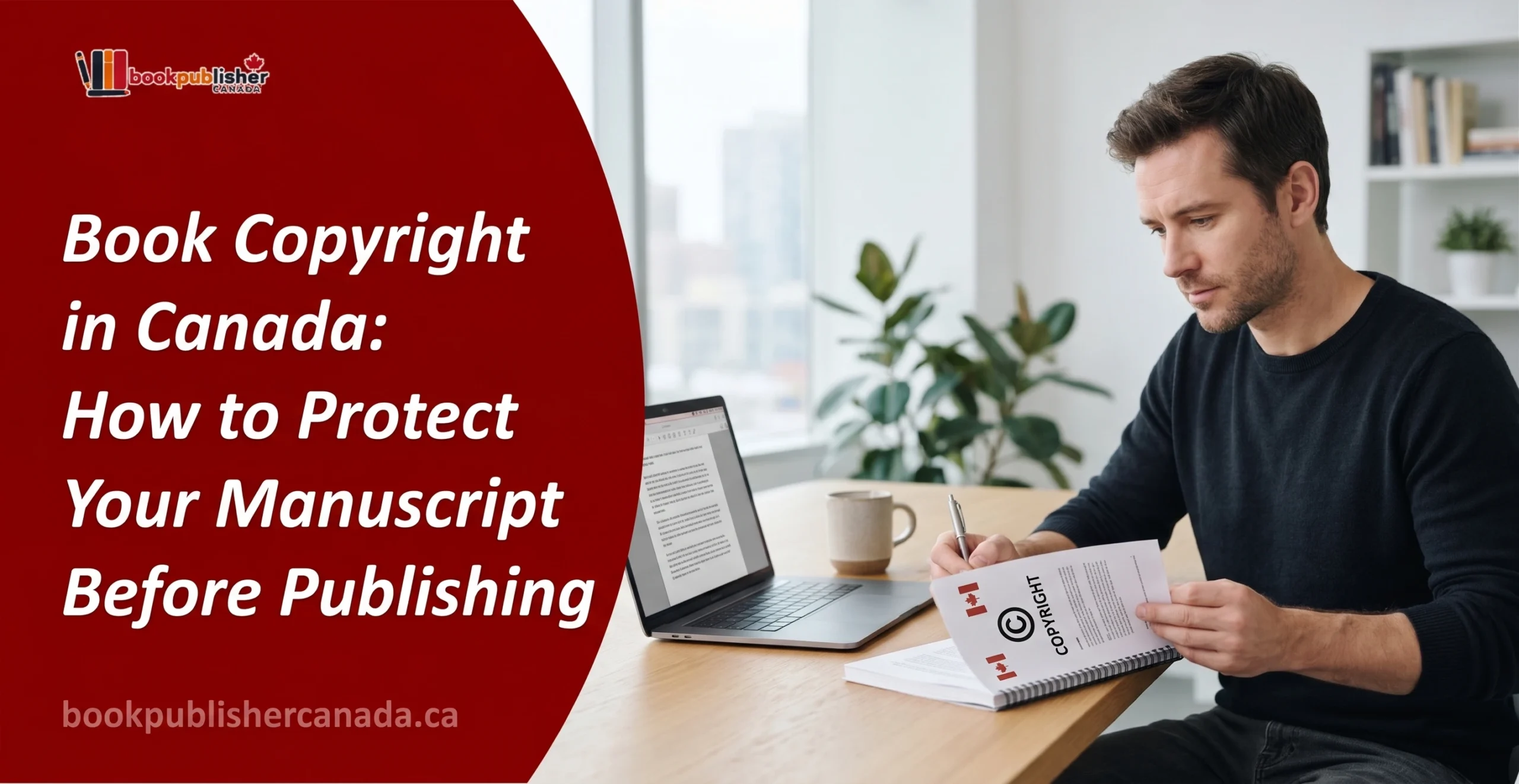
Book writing includes elements such as creativity, research, and lots of work. It is always good to have knowledge of copyright protection in Canada before an author submits a book to an editor or publisher. Copyright can protect one’s creation, such as a book, which is a literary work, from reproduction, publishing, and distribution. This knowledge will help prevent any problems regarding ownership before publishing.
Copyright protection usually starts automatically with the creation and fixation of the literary work. Authors are not required to publish their works or register them in order to gain copyright protection at first. A novel, a poetry book, an educational manuscript, or even a nonfiction can be considered a literary work under the copyright act of Canada.
For authors researching how to copyright a book in Canada, the most important distinction is between an original idea and its written expression. Copyright protects the actual content created by an author rather than general concepts, themes, titles, or story ideas. For example, a writer may protect an original fictional narrative, but cannot claim exclusive ownership of a general idea about a detective solving a mystery.
While copyright protection is automatic, keeping detailed records will ensure that the author can prove the creative process as well as ownership in case of future queries.
Some ways to safeguard the manuscript include the following:
Writers should also understand that ways to protect my book idea differ from protecting completed creative work. A general premise cannot usually receive copyright protection by itself. However, the original manuscript expressing that premise may qualify for protection.
While copyright does not require registration, it may help in demonstrating ownership rights. Those who desire legal proof may use the Canadian Intellectual Property Office copyright registration service.
Authors researching copyright registration in Canada should understand that the certificate can be used as evidence in legal proceedings, although its evidentiary value may be challenged. CIPO does not independently investigate the originality or ownership claims submitted in registration applications.
Search for Copyright Registration Canada must consequently be oriented toward comprehending the automatic protection granted by Canadian legislation as well as the additional importance of registration as evidence.
The registration process involves submitting an application with accurate information about the literary work and its ownership. Authors can use the online application system provided by the Canadian Intellectual Property Office.
The common process involves:
CIPO doesn’t ask for the submission of a copy of the manuscript along with the application form. The registration certificate will be issued after fulfilling the above requirements.
Authors should consult the official fee schedule before applying because registration costs and administrative requirements can change.
Differentiating between automatic protection and registration allows writers to make decisions on whether or not they need a certificate.
| Comparison | Automatic Copyright | Registered Copyright |
| Protection commences | At the creation and fixation of an eligible work | Protection exists prior to registration |
| Registration | Not needed | Optional process |
| Documentations | Original works of creation | Copyright registration certificate |
| Ownership proof | Dependent on relevant documents | Statutory evidentiary rights |
| Cost of registration | No registration fees | Government registration fee |
Learning how to copyright a manuscript Canada can enable writers to make well-informed decisions when registering their creations to prove ownership.
Ownership of copyrights is normally vested with the author who creates the original literary work. However, there may be some exceptional circumstances that will alter copyright ownership from what would be normally expected.
At this stage, Author Publishing decisions should include a careful review of manuscript ownership, licensing permissions, and contractual responsibilities. Authors should distinguish between hiring a professional to prepare a manuscript for publication and transferring copyright ownership to another party.
Publishers must consider whether their publishing agreement allows for more editions, translations, audio books, and even adaptations of the book into different forms. Well-written agreements will prevent future complications with regard to how a manuscript is to be utilized once it is published. Before signing any contract, writers need to make sure that the rights being granted align with their publishing objectives.
A well-written publishing agreement will outline all aspects of reproduction, distribution rights, territories, royalties, exclusivity, and transfer of ownership. Writers should consider moral rights, which pertain to attribution of the work and certain types of distortions of a work. Moral rights cannot be assigned, but they may be waived.
Professional book publishers may provide editing, proofreading, cover design, formatting, printing, and distribution without automatically acquiring copyright ownership. The actual agreement determines which permissions are granted and whether any ownership rights are transferred.
Publishing through Amazon Kindle Direct Publishing does not automatically transfer an author’s copyright to the platform. Authors generally retain ownership while granting the permissions described in the platform’s publishing terms.
Writers are required to ensure that they hold copyrights to all the materials that they use in their manuscripts, such as photographs, images, quotations, and contributions from others. This includes making sure that they understand the distribution and exclusivity issues involved.
Understanding author rights Canada requirements helps writers make informed decisions about digital editions, print-on-demand publishing, and international distribution while maintaining appropriate control over their original work.
Prior to the release of any manuscript, the author must make sure that he or she has sorted out all the ownership documents, publishing contract, permissions from third parties, and registrations, if any. It is also essential that the author keeps copies of all signed contracts and knows exactly what rights the editor, designer, distributor, and publisher have.
The copyright protection serves as a good basis for responsible publishing, but it cannot serve as a substitute for meticulous reviewing of contracts and consultation with a lawyer in cases of ownership disputes.
It is crucial for an author to protect his/her manuscript prior to its publication since this will enable him/her to retain control over the original work and to make informed decisions when it comes to publishing. Learning about copyright in Canada, keeping dated records of manuscripts, registering one’s work voluntarily, and analyzing publishing contracts are ways through which ownership issues can be minimized. Whether it is through conventional publishers or Amazon KDP and Kindle, the author needs to know the rights he/she retains and permissions he/she grants.